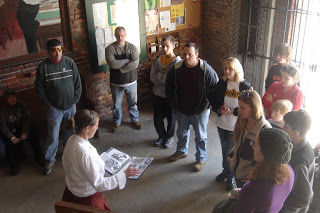
Haunted Cotton Exchange


Haunted Cotton ExchangeTour

by Tour Old Wilmington

Visit the historic and haunted Cotton Exchange one of the most haunted locations in

Wilmington NC.

Hear one of the best story tellers in town.

Tours Daily, Call for tour times!

910 409 4300

Adults, (13 & up) $12

Kids (ages 5 to 12) $5

Single Travelers $25

Dogs free

Group rates available

Bus Step On Guide Service for Wilmington and surrounding beaches.

By Tour Old Wilmington

910-409-4300

5 Star Story Teller!


Scary, creepy and mostly ghostly tales!


Chills and Thrills await you at the one of the most historic & haunted locations in Wilmington

Locally owned and operated since 2009

Group and Private Tours available, call for rates


Have your i phone ready!

Things are happening everyday!


Paddies Hollow Ghost

Paddies Hollow Ghost
Taken by Lori Erwin 2004

Write a review with Trip Advisor

TripAdvisor
Review Haunted Cotton Exchange Tours
Showing posts with label Ghost in Wilmington. Show all posts

Review and Recent Ghost Sighting At the Cotton Exchange

Hi, Lori!  My name is Becky, and my two children and I did a tour with you on Thursday, Aug 2 at the Cotton Exchange.  First of all, I wanted to say we enjoyed ourselves immensely!  Your stories were quite fascinating.  I just thought I'd share a picture that I took with you to get your opinion.  Its from the window of the doggy store.  My son said he felt an odd feeling there, so I snapped a pic, and I think I see something.  If you look in the bottom of the frame, you can see my son's whole face being reflected from the glass.  Just slightly above that, to the left of the white dog display, I see what looks like a child's face.  Maybe its just our imagination, so we thought we'd see what you thought about it.  Thanks again for an enjoyable evening!  We had a blast!

Sincerely,
Becky C

Ghost at Paddy's Hollow?

Haunted Cotton Exchange Tours!  

Group Discounts for 10 or more. 
12 and under FREE with paying adult. 
Fred the ghost at the Cotton Exchange. Can you see him? 

Come spend some creepy time with us! 
5 Star rated tour guide. 

Call for tour times! 
910-409-4300


Getting away with murder during the Civil War


Getting away with murder!  Part One
The battlefield claimed many a brave officer, but there were a few others who met not-quite-so-honorable ends

The death toll among general officers during the Civil War was staggering. Because military necessity often placed a general officer at the head of the army, generals were killed leading hopeless charges (Lewis A. Armistead), engaging in skirmishes (J.E.B. Stuart), reconnoitering occupied territory ("Stonewall" Jackson) and mounting impossible frontal attacks (Patrick R. Cleburne). The cost was incalculable. Here, after all, were officers who—political favoritism aside—presumably rose to their rank because of their experience, judgment and valor, the men who were best qualified to achieve their respective armies' objectives. And yet they fell in alarming numbers. At Franklin alone, the number of Confederate generals killed or wounded ran in the double digits.

Such a death was almost expected. However tragic a general's demise might be, however demoralizing to his troops, it was a risk every soldier anticipated his leaders taking, sharing with the lowliest private the ultimate possibility of a noble, if gory, demise.

And then there were the generals whose violent departures had little if anything to do with the field of battle.


 Jefferson Columbus Davis
Library of Congress: LC-USZ62-129704

The killer was a Union general who bore the unenviable name of Jefferson C. Davis—a fact that doubtless caused him no end of embarrassment. Davis was born in 1828 near the town of Charleston, Ind., and had been soldiering since his teens, when he volunteered for service as a private in the Mexican War. As a lieutenant five years later, he fought in the last Seminole campaign. And when Fort Sumter was fired on in 1861, Davis was inside the walls, commanding a four-gun battery. Throughout the war, he demonstrated unusual bravery and tenacity in battle, and distinguished himself in the Blackwater Expedition and at Pea Ridge. He was made brigadier general of volunteers in May 1862.

After a brief leave due to illness and exhaustion, Davis reported in early September 1862 to General Horatio G. Wright, commanding the Army of the Ohio. Wright in turn directed Davis to report to his second in command, Maj. Gen. William Nelson, in Louisville, Ky. A worse pairing could not have been conceived.

At 5 feet 7 inches tall and weighing 125 pounds, Davis looked a bit hangdog and considerably older than his 34 years. Although generally quiet in his demeanor, he was often intractable and given to displays of temper. One biographer described Davis as "aggressive, feisty, and confrontational" with a "fiery and combative spirit." The bombastic Nelson stood 6 feet 2 inches tall and weighed some 300 pounds—a veritable bearded, curly haired giant. Nelson was four years Davis' senior and had joined the Navy as a midshipman in 1840. He, too, had seen his share of action and in 1847 had commanded a battery at the Battle of Vera Cruz. A lieutenant when the Civil War began, he swiftly rose to the rank of major general in Don Carlos Buell's Army of the Ohio. Apparently Nelson was something of a bully and in his Navy days had been given the nickname "Bull."

Further exacerbating the situation was the sectional enmity that existed between Indiana and Kentucky. Never one to mince words, Kentuckian Nelson was known to refer to Hoosiers as "poor trash"—an attitude unlikely to endear him to Jeff C. Davis, one of Indiana's favorite sons. Davis, an Army veteran of countless engagements, might also have resented having to report to a man who had spent his entire career in the Navy and had only recently been given command of troops. And when Davis reported to Nelson, he was ordered to organize and train the "home guard"—an assignment Davis almost certainly would have considered beneath him.

Some, or perhaps all, of these factors were at play when, two days after receiving his assignment, Davis reported to Nelson at the Galt House, a luxurious hotel that also served as Army offices and Nelson's quarters. Nelson asked Davis for the number of troops mustered and the number of weapons required. When Davis replied, "I don't know," Nelson became indignant. He then asked for details relating to recently formed regiments and companies, and again Davis answered that he didn't know. Davis later averred that after only two days on the job and still lacking some crucial reports, he couldn't possibly have answered otherwise.

Nelson exploded. Rising to his full height, he dressed Davis down: "But you should know. I am disappointed in you, General Davis. I selected you for this duty because you are an officer in the regular Army, but I find I made a mistake."

According to Maj. Gen. James B. Fry, Buell's chief of staff, an old friend of Davis and a witness to the encounter:
"Davis arose and remarked in a cool, deliberate manner:

"'General Nelson, I am a regular soldier, and I demand the treatment due to me as a general officer….I demand from you the courtesy due to my rank.'

"Nelson replied: 'I will treat you as you deserve. You have disappointed me; you have been unfaithful to the trust I have reposed in you, and I shall relieve you at once….You will proceed to Cincinnati and report to General Wright.'

"Davis said: 'You have no authority to order me.'
"Nelson turned toward the Adjutant General and said: 'Captain, if General Davis does not leave the city by nine o'clock tonight, give instructions to the Provost-Marshal to see that he shall be put across the Ohio!'"

Furious, Davis reported to Wright, who defused the situation by temporarily reassigning him. On September 25, Buell took over from Nelson, and Wright felt it safe to send Davis back to Louisville. Davis was elated with the assignment; he relished a chance to serve under Buell as he planned a major campaign against the Rebels in Kentucky. On September 29, Davis entered the Galt House to report and immediately found himself among several friends, including Indiana Governor Oliver P. Morton. Shortly thereafter, Nelson entered the hotel. Davis, still smarting from the insult, approached Nelson and demanded an apology. Morton stood near enough to hear the exchange, as did the ubiquitous Fry. According to Fry, Nelson answered, "No!" and "said in a loud voice for all to hear, 'Go away, you damned puppy, I don't want anything to do with you!'"

Davis was holding a piece of paper, which—as the shocked assemblage watched—he wadded up and flicked into Nelson's face; a startled Nelson responded by slapping Davis with the back of his hand. He made an indignant comment to Morton, and stalked away toward the staircase leading to his room. Infuriated, Davis borrowed a pistol from a friend, and walking to within three feet of Nelson, shot the unarmed general in the chest. Nelson, mortally wounded, managed to climb the stairs before he collapsed. "Send for a clergyman," he gasped, "I wish to be baptized. I have been basely murdered."

Fry immediately arrested Davis, who pleaded that, while he had sought an apology, it was never his intention to shoot Nelson. The shooting created a furor among the officers at the hotel, some of whom called for Davis' immediate hanging. Buell, who had doted on Nelson, was outraged and considered the act "a high crime and gross violation of military discipline." He wanted to take swift action, but timing worked in Davis' favor.

With his huge offensive in the works, Buell simply could not spare the officers or the time needed to convene a court-martial, and requested that Davis be tried in Washington. Morton lobbied on Davis' behalf, however, and nothing further was made of the affair. After a week of incarceration, Davis was released, and within two weeks of murdering "Bull" Nelson, he was given division command in General William S. Rosecrans' Army of the Cumberland. He fought gallantly throughout the remaining years of the war, but he would always be remembered as the only Union general to have murdered a brother officer.

picture source: http://germansons.com/Metzner_Collection/Davis_J.html#


SUBSCRIBE TODAY

· Read more inAmerica's Civil War magazine


· Subscribe online and save nearly 40%!!!

Face in the window?


We were out in Oakdale Cemetery doing some history research when we discovered the Murchaison family plot.  As soon as we stepped into the plot, we both got chills and felt like some one was watching us. We took this picture thru the window of the crept.  Can you see the face?

Walking sounds at the Cotton Exchange

I work down at the Cotton Exchange in one of the upstairs offices.  We have between 10 to 16 people working there day and night.  I'm on the night shift.  We have something, ghost or something that walks back and forth my row of cubicals'.  The floors are wooden had make a very recognizable sound when walked on.


You can hear footsteps starting at one end of the passage way, about 15 feet, then the door at the end opens, very slowly, stays open for a second and then slams shut, very loud.  I would love to see if anyone else has see or heard anything

Maco Light

On a night in 1867, at the small Brunswick County station of Maco fifteen miles west of Wilmington, a slow freight train was puffing down the track.  In the caboose was Joe Baldwin, the flagman.  A jerking noise startled him, and he was aware that his caboose had become uncoupled from the rest of the train, which went heedlessly on its way.  As the caboose slackened speed, Joe looked up and saw the beaming light of a fast passenger train bearing down upon him.  Grabbing his lantern, he waved it frantically to warn the oncoming engineer of the imminent danger.  It was too late.   At a trestle over the swamp, the passenger train plowed into the caboose.  Joe was decapitated:  his head flew into the swamp on one side of the track, his lantern on the other.  It was days before the destruction caused by the wreck was cleared away.  And when Joe's head could not be found, his body was buried without it.
Thereafter on misty nights, Joe's headless ghost appeared at Maco, a lantern in its hand.  Anyone standing at the trestle first saw an indistinct flicker moving up and down, back and forth.  Then the beam swiftly moved forward, growing brighter and brighter as it neared the trestle.  About fifty feet away it burst into a brilliant, burning radiance.  After that, it dimmed, backed away down the track, and disappeared.

It was Joe with his lantern, of course.  But what was he doing?   Was he looking for his head?  Or was he trying to signal an approaching train?

In 1889 President Grover Cleveland, on a political campaign, saw the mysterious light, as have hundreds of people throughout the years.  But in 1977 when the railroad tracks were removed and the swamp reclaimed his haunting grounds, Joe seems to have lost interest in Maco.  At least, he has not been seen there lately.

Stories all come from North Carolina Legends by Richard Walser.  This book is available from the Historical Publications Section, Division of Archives and History, 109 E. Jones Street, Raleigh, NC 27601-2816 or 919-733-7442.
We greatly appreciate their generosity in allowing us to reprint these stories.

Murchison Tomb At Oakdall

I came upon the Murchison grave.  I was taking pics in the crept and suddenly overcome with a feeling of dread.   My skin tingled and goosebumps everywhere.   See if you can spot the "face".  Very creepy!


Haunted
Tour Old Wilmington tm

Scary, creepy and mostly ghostly
Tales.
Chills and Thrills await you at the one of the most historic & haunted locations in Wilmington.
  Tours 7 days a week
Under 12 Free
All Others $12 each
Group, Private and Bus Tours available
Call for Tour Times
(910) 409-4300
www.HauntedTourOldWilmington. blogspot.com
Haunted Tours are so secrect you'll have to call for location!
Bring your camera!  Things are happening everyday!
Who is that at the top of the stairs?  We check and there was NO one up there. Rest of the pics I took were perfect.
Is the Bellamy really haunted?